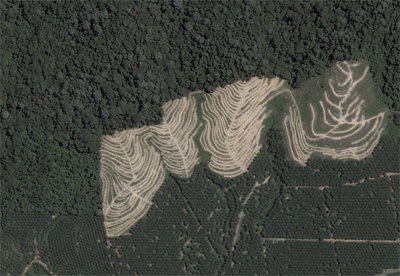
The Palm Oil

Oil palm, Elaeis guineensis, was introduced to Malaya in 1870 from West Africa. This hardy crop starts bearing fruit within 2 1/2 to 3 years and keeps bearing fruit for up to 25 years, making it the longest yielding crop in the world.

The fleshy outer layer produces crude palm oil and the seed yields palm kernel oil.

Palm oil is used in a variety of industries from the commercial manufacturing of food and beauty products to the manufacturing of non-food products.
Showing posts with label Indonesia. Show all posts

Tuesday, January 1, 2013

Challenging Times Ahead


31/12/2012 (Business Times) - SEPTEMBER 11 2011 is the date Palm Oil Refiners Association of Malaysia (Poram) members will always remember. 

It was the day the Indonesian government announced its intention to widen the tax gap between crude and refined palm oil.

This made crude palm oil (CPO) and crude palm kernel oil very cheap for downstream businesses in Indonesia. 

On top of that, processed palm oil in the form of cooking oil, soaps and detergents shipped out from there are minimally-taxed.

Indonesia's move, since October 2011, created an unfair playing field as refiners in Malaysia found it difficult to source for affordable feedstock. 

Price cutting ensued as refiners, oleochemicals, specialty chemicals, specialty fats and biodiesel producers in Malaysia fight for their survival.

As downstream businesses in Malaysia bled losses, those in Indonesia laughed all the way to the bank. Oil palm planters in both countries, however, have to contend with falling prices.

Poram chief executive officer Mohammad Jaaffar Ahmad noted that besides refiners in Indonesia, the biggest gainers are palm oil consumers around the world, while the biggest losers are oil palm planters in Malaysia and Indonesia.

"With falling prices, it's not a surprise that palm oil exports is not able to match last year's record high of RM80 billion," he said.

In the first 11 months of this year, the Malaysian Palm Oil Board reported the country had only shipped out RM65.89 billion worth of palm oil products. 

China, Malaysia's biggest palm oil client had so far only bought 3.15 million tonnes. This is a 14 per cent shortfall from 3.67 million tonnes, posted a year ago.

Jaaffar noted China imports more than three quarters of its cooking oils and bakery fat demand. Palm oil is the second most consumed there after soyaoil.

Last week, Oil World forecasts China likely to import 61.7 million tonnes of soyabeans from the United States, Brazil and Argentina next year, four per cent more than this year's 59.2 million tonnes.

Jaaffar explained that in the last few years, China had started to import more soyabeans instead of soyaoil because it wants more crushing of soyabeans to get more soyameal to feed its pig, cattle, dairy and poultry farms.

On the other hand, India, Malaysia's second biggest market, bought 2.35 million tonnes of palm oil. This worked out to be 53 per cent more than last year's 1.54 million tonnes.
Higher shipments into India was prompted by policy changes in India and Malaysia.

Since July 2012, India, which imports more than half of its total vegetable oil consumption of about 16 million tonnes a year, ended a six-year freeze on the base import price of refined palm olein, allowing easier imports of CPO. 

At the same time, the Malaysian government waived export duty on five million tonnes of CPO, assuming more CPO exports to India would drive down stock level and prompt palm oil prices to rise again. 

However, it did not materialise. This is because the exports of more duty-free CPO dimmed the investment climate for refiners. 

"Poram members operated at half capacity and this itself was strong enough justification to keep CPO for downstream businesses. Every tonne of duty-free CPO exports resulted in loss of market potential for every tonne of refined oil," Jaaffar said.

"It was not just the sacrifice of CPO because refiners also produce olein, stearin, palm fatty acid distillate and palm kernel oil for the oleochemical, specialty chemicals, specialty fats and biodiesel sectors," he added.

Ancillary services supporting these businesses such as logistics, packaging and bulking facilities continued to suffer.

As palm oil stock level continues to rise and prices suddenly plunged in October, the government was compelled to respond to refiners' plea. 

The policy change to lower the tax from the 23 per cent and stop exports of duty-free CPO, however, was not immediate. 

"It's better late than never," Jaaffar heaved a sigh of relief. 

From tomorrow onwards, the 2013 palm oil tax structure will be lowered from 23 per cent to stagger at between 4.5 per cent and 8.5 per cent. 

If palm oil price hovers between RM2,250 and RM2,400 a tonne, the tax is 4.5 per cent. And if the palm oil prices were to jump to RM3,450 per tonne, the tax is 8.5 per cent.

Designed to fluctuate on a monthly basis, February's palm oil tariffs will be announced on January 15. 

Jaaffar said since Malaysia's new palm oil tax structure will be similar to that of Indonesia, refiners here would stand a better chance to buy up more CPO and reduce the current high stock levels in the country.

This will spur refining activities and players would be able to reap economies of scale and make some money to stay in the business.

Asked on the outlook for 2013, Jaaffar expressed cautious optimism. His reservation stems from possible rejection of palm cooking oil shipment to China.

Every year, China's food processing companies spend billions of dollars to buy close to four million tonnes of the kitchen staple from Malaysia.

"Effective January 1 2013, palm oil shipments into China that do not meet the 2009 edible oils quality control specification will be turned away," said Jaaffar.

Despite Poram's appeals on the practicalities of trading in meeting China's Inspection and Quarantine Bureau specification, it seems "off-spec" shipment can no longer be re-refined at its shores. 

This is not in line with the usual trading norms. 

Jaaffar is concerned China's move may re-ignite similar demands from other palm oil clients. 

As early as in the late 1970s to early 1980s, trading corporations in Pakistan and India had demanded for guaranteed landing quality and weight without wanting to pay for cost-adding arrangements.

If palm oil exporters were to surrender to demands that are not of the usual business practice, this exposes them to risks of being manipulated without any explicit avenue to legal redress or compensation. "What redress can our members avail to?" he asked.

With a heavy sigh, Jaaffar said Poram has no choice, but to advise exporters to be cautious when selling palm oil to China. 

"Our members will be trading at their own risks." 


http://ecx.images-amazon.com/images/I/510AaorrQpL._BO2,204,203,200_PIsitb-sticker-arrow-click,TopRight,35,-76_AA300_SH20_OU01_.jpg


Wednesday, May 4, 2011

Southeast Asian Palm Oil Firms Go on African Land

03/05/2011 (Reuters) - Southeast Asian palm oil firms are turning to Africa as land runs out back home and world demand for cheap cooking oil soars, but the continent's harsh weather, high costs and land disputes could derail their plans.

Malaysia's Sime Darby and Singapore's Golden Agri Resources have joined a slew of global firms entering Africa by snapping up hundreds of thousands of hectares of land in Liberia, but it could still take years to turn the region into a net exporter and help ease high palm oil prices.

With an increasing number of firms rushing to Africa as part of a global grab for land in the face of soaring food prices, African governments such as Nigeria and Tanzania have also thrown open their doors to planters by offering tax breaks and big land concessions.

But a lack of clear land titles, poor margins and weak yields could turn out to be massive stumbling blocks.

"Africa is not a dream continent for palm oil. We have been here for 30 years and we get on by with small profits," said Gert Vandersmissen, director of operations in Gabon for Belgium's Siat Group. "The costs can be high."

But with Malaysia and Indonesia, which together account for 85 percent of the world's palm oil output, likely to run out of land soon, the two Southeast Asian countries don't have many alternatives.

Nomura said in a recent note that strict environmental rules will see both Southeast Asian countries run out of land by 2020-2022, a century after colonial planters introduced oil palms to the region.

RUNNING OUT

Top palm producer Indonesia is preparing for a forest clearing ban this year as part of a $1 billion climate change deal with Norway, and No.2 supplier Malaysia has used up nearly all its land.

At the same time, the world faces a supply deficit of palm oil -- used in a range of products from biscuits and shampoo to biofuels -- that may exceed 246,000 tonnes in the current marketing year to September, according to U.S. Department of Agriculture data.

Malaysian palm oil futures, the benchmark for the market, are forecast to average a record $1,114 this year.

The potential to ramp up output by tapping Africa is huge.

World Bank studies show Sub-Saharan Africa holds 201.5 million hectares suitable for crops, nearly half the world's total, or 16 times the combined oil palm acreage in Indonesia and Malaysia.

Unlocking Africa's land at a pace of 1 million hectares a year over two decades could boost its output to 38 million tonnes from 1.9 million tonnes in 2010, Reuters calculations based on Food and Agriculture Organisation (FAO) data showed.

That could turn Africa into a major net exporter. Last year, the continent imported 3 million tonnes, an increase of 15 percent, according to Malaysian Palm Oil Council.

"Those who have announced their expansion into Africa, for example, Sime Darby ... are only looking for first mover's advantage," said Citigroup analyst Penny Yaw in Malaysia.

Golden Agri Resources, Singapore's second largest palm oil firm, plans to invest in Liberia-based Golden Veroleum, which has signed a $1.6 billion deal with the government of Liberia for a 500,000 acre estate in the southeast of the country.

The world's largest listed planter by land holdings, Sime Darby, has a 220,000 hectare concession in Liberia. It started planting this year with first maturity expected after the fourth year of planting.

BUT IS IT ALL WORTH IT?

Investors are often lured by the fact that land in Africa can be rented or bought at a fraction of the price in Malaysia, where estates are priced at $6,000 to $7,000 per hectare, but there are other hidden costs.

Projects can get delayed if deals between land-hunting firms and African states do not ensure local people in the world's hungriest continent reap any benefit, leaving the door open to potential social tension.

Compensation and mapping of land rights can also be expensive, adding to production costs which range between $600 to $800 for a tonne of palm oil in Africa compared to around $300 in Asia, a survey of five planters in Africa showed.

"Some might argue that shipping from Africa to Europe can reduce costs but it's not enough," said a planter in Ghana. "For every advantage there is a cost. Labour is cheap but it takes time to teach them and this leads to lower productivity."

There are other disadvantages such as low yields.

Estates in Africa's top grower, Nigeria, yield about a tenth of Malaysia's 21.3 tonnes of fresh fruit bunches a hectare, FAO data shows, due to poor planting materials and the region's long dry season that stresses out water-loving oil palms.

Despite these problems, there is opportunity in Africa.

The World Bank in April lifted an 18-month ban on lending to palm oil on social and environment concerns to focus on financing projects that help small farmers -- a move that may help spur expansion.

Malaysia's state-linked FELDA Global Group, the world's largest palm estate operator, wants to replicate its smallholder co-operative model in Africa and sell planting materials and technical expertise in exchange for long-term supplies.

"Buying land in Africa is tricky and we prefer to cater to government requests to start up the FELDA model. We have one project in Sierra Leone," said FELDA Global Group President Sabri Ahmad. "We can be the palm oil salesman in Africa."

 Africa Cooking Oil
Raw Palm Oil From Ghana - 32 OzNatural Red Palm Oil, 17.2 oz.Commerce and Economic Change in West Africa: The Palm Oil Trade in the Nineteenth Century (African Studies)Golden Palm OilSmall-Scale Palm Oil Processing in Africa (Fao Agricultural Services Bulletin,)The 2011 Import and Export Market for Crude Palm Oil in South AfricaPalm Oil and Small ChopThe Oil Palm (World Agriculture Series)The Palm Oil MiracleThe 2009-2014 World Outlook for Once-Refined Palm Oil after Alkali or Caustic Wash but before DeodorizingPalm Oil and Protest: An Economic History of the Ngwa Region, South-Eastern Nigeria, 1800-1980 (African Studies)Diseases And Disorders Of The Oil Palm In MalaysiaOil Palm: Cultivation, Production and Dietary Components