
03/05/2011 (Reuters) - Southeast Asian palm oil firms are turning to Africa as land runs out back home and world demand for cheap cooking oil soars, but the continent's harsh weather, high costs and land disputes could derail their plans.
Malaysia's Sime Darby and Singapore's Golden Agri Resources have joined a slew of global firms entering Africa by snapping up hundreds of thousands of hectares of land in Liberia, but it could still take years to turn the region into a net exporter and help ease high palm oil prices.

With an increasing number of firms rushing to Africa as part of a global grab for land in the face of soaring food prices, African governments such as Nigeria and Tanzania have also thrown open their doors to planters by offering tax breaks and big land concessions.
But a lack of clear land titles, poor margins and weak yields could turn out to be massive stumbling blocks.
"Africa is not a dream continent for palm oil. We have been here for 30 years and we get on by with small profits," said Gert Vandersmissen, director of operations in Gabon for Belgium's Siat Group. "The costs can be high."

But with Malaysia and Indonesia, which together account for 85 percent of the world's palm oil output, likely to run out of land soon, the two Southeast Asian countries don't have many alternatives.
Nomura said in a recent note that strict environmental rules will see both Southeast Asian countries run out of land by 2020-2022, a century after colonial planters introduced oil palms to the region.
RUNNING OUT
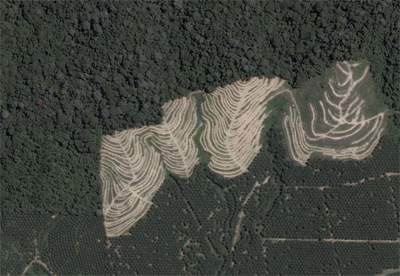
Top palm producer Indonesia is preparing for a forest clearing ban this year as part of a $1 billion climate change deal with Norway, and No.2 supplier Malaysia has used up nearly all its land.
At the same time, the world faces a supply deficit of palm oil -- used in a range of products from biscuits and shampoo to biofuels -- that may exceed 246,000 tonnes in the current marketing year to September, according to U.S. Department of Agriculture data.
Malaysian palm oil futures, the benchmark for the market, are forecast to average a record $1,114 this year.
The potential to ramp up output by tapping Africa is huge.

World Bank studies show Sub-Saharan Africa holds 201.5 million hectares suitable for crops, nearly half the world's total, or 16 times the combined oil palm acreage in Indonesia and Malaysia.
Unlocking Africa's land at a pace of 1 million hectares a year over two decades could boost its output to 38 million tonnes from 1.9 million tonnes in 2010, Reuters calculations based on Food and Agriculture Organisation (FAO) data showed.
That could turn Africa into a major net exporter. Last year, the continent imported 3 million tonnes, an increase of 15 percent, according to Malaysian Palm Oil Council.

"Those who have announced their expansion into Africa, for example, Sime Darby ... are only looking for first mover's advantage," said Citigroup analyst Penny Yaw in Malaysia.
Golden Agri Resources, Singapore's second largest palm oil firm, plans to invest in Liberia-based Golden Veroleum, which has signed a $1.6 billion deal with the government of Liberia for a 500,000 acre estate in the southeast of the country.
The world's largest listed planter by land holdings, Sime Darby, has a 220,000 hectare concession in Liberia. It started planting this year with first maturity expected after the fourth year of planting.
BUT IS IT ALL WORTH IT?

Investors are often lured by the fact that land in Africa can be rented or bought at a fraction of the price in Malaysia, where estates are priced at $6,000 to $7,000 per hectare, but there are other hidden costs.
Projects can get delayed if deals between land-hunting firms and African states do not ensure local people in the world's hungriest continent reap any benefit, leaving the door open to potential social tension.

Compensation and mapping of land rights can also be expensive, adding to production costs which range between $600 to $800 for a tonne of palm oil in Africa compared to around $300 in Asia, a survey of five planters in Africa showed.
"Some might argue that shipping from Africa to Europe can reduce costs but it's not enough," said a planter in Ghana. "For every advantage there is a cost. Labour is cheap but it takes time to teach them and this leads to lower productivity."
There are other disadvantages such as low yields.

Estates in Africa's top grower, Nigeria, yield about a tenth of Malaysia's 21.3 tonnes of fresh fruit bunches a hectare, FAO data shows, due to poor planting materials and the region's long dry season that stresses out water-loving oil palms.
Despite these problems, there is opportunity in Africa.
The World Bank in April lifted an 18-month ban on lending to palm oil on social and environment concerns to focus on financing projects that help small farmers -- a move that may help spur expansion.
 Malaysia's state-linked FELDA Global Group, the world's largest palm estate operator, wants to replicate its smallholder co-operative model in Africa and sell planting materials and technical expertise in exchange for long-term supplies.
"Buying land in Africa is tricky and we prefer to cater to government requests to start up the FELDA model. We have one project in Sierra Leone," said FELDA Global Group President Sabri Ahmad. "We can be the palm oil salesman in Africa."
Africa Cooking Oil


