The Palm Oil

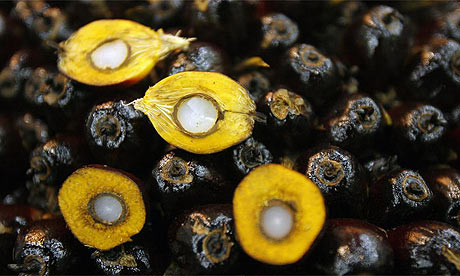
Oil palm, Elaeis guineensis, was introduced to Malaya in 1870 from West Africa. This hardy crop starts bearing fruit within 2 1/2 to 3 years and keeps bearing fruit for up to 25 years, making it the longest yielding crop in the world.

The fleshy outer layer produces crude palm oil and the seed yields palm kernel oil.

Palm oil is used in a variety of industries from the commercial manufacturing of food and beauty products to the manufacturing of non-food products.
Showing posts with label indonesian palm oil. Show all posts

Wednesday, April 6, 2011

US Expects To Boost Economic Cooperation In Agriculture


06/04/2011 (Jakarta Post) - The United States hopes to seek new business opportunities and enhance bilateral cooperation with Indonesia by sending an agribusiness, trade and investment delegation mission.

The delegation will be led by US Department of Agriculture Acting Under Secretary Michael Scuse, accompanied by representatives from 19 companies from the agricultural sector including multinational agricultural biotechnology corporation Monsanto and the world’s leading agricultural and construction equipment firm Case New Holland, in a four-day visit starting on Monday.

Scuse said on Tuesday that the US wanted to boost trade relations and investments — especially in agriculture — with Indonesia, which had showed promising economic growth.
“It is one of the Southeast Asia’s fastest growing economies, with vibrant business climate and upwardly mobile, expanding middle class providing opportunities to expand exports of US food and agricultural goods and stimulate investment,” he told a press briefing in Jakarta. 

He added that, along with economic growth, Indonesia’s needs for food would rise and the US would continue to supply its high-quality and safe agricultural products. 

“There’s a hope that we’ll be able to export more grains and see an increased market for beef and poultry products in Indonesia,” he said. 
Meanwhile, Deputy Agriculture Minister Bayu Krisnamurti said Indonesia also asked the US to open more access to Indonesian palm oil — especially in the form of bio-fuel — and cacao. 

“Currently, we are producing around 1.5 million to 2 million tons of sustainable palm oil. There’s much potential for our palm oil in the US market,” he said. 

Scuse said he also offered Indonesia the latest American agricultural technology to help the former country in ensuring its food security.

Bayu said Indonesia would cooperate with the US to develop advanced agricultural technology in a bid to adjust to climate change. 

“We want to build cooperation with them to develop seeds which are more resilient to extreme climate through research and development programs,” he said.

Scuse said the US also expected to double exports to Indonesia by 2014, along with increased investments.

Last year, the US’ overall export to Indonesia reached US$5.6 billion with around $2.3 billion, nearly 40 percent, contributed by food, agricultural and fish products, he said.

Meanwhile, Indonesia’s export to the US, its major export destination, was valued at $15.6 billion with about $4.1 billion coming from agricultural, fish and forest products, he added.

The US is Indonesia’s largest foreign investor after Singapore and the UK with a total investment of $930 million last year, accounting for 5.7 percent of the total investment of Rp 208.5 trillion ($23.98 billion). 

Separately, Franky Widjaja, the Indonesian Chamber of Commerce and Industry deputy chairman for agribusiness, food and forestry, said Indonesia might take advantage of the technology offered by the US to boost the productivity of its crops such as rice, corn and palm oil. 

He cited oil palm plantations managed by small holders, which accounted for almost 40 percent of the country’s total oil palm plantations of 7.3 million hectares, could only produce 3 tons of crude palm oil per hectare, almost half of the output of major plantations. 

“Enhancing productivity is one of our big challenges,” he said.


Indonesian Agriculture

Indonesian Exports, Peasant Agriculture, and the World Economy, 1850-2000: Economic Structures in a Southeast Asian State (Ohio RIS Southeast Asia Series)The Decentralization of Forest Governance: Politics, Economics and the Fight for Control of Forests in Indonesian Borneo (The Earthscan Forest Library)From Slash-and-Burn to Replanting: Green Revolutions in the Indonesian Uplands (World Bank Regional and Sectoral Studies)Integrated Assessment of the Impact of Trade Liberalization: A Country Study on the Indonesian Rice Sector

Monday, December 20, 2010

Why Indonesia needs ISPO

Sustainable palm oil and RSPO

Sustainable palm oil has been the topic of discussion among the members of the palm oil sector since 2003, the year when the players in the sector held the first meeting to set up is the Roundtable on Sustainable Palm Oil which was eventually formed a year later and registered in Zurich, Switzerland on April 8, 2004 as an association. It was created by private stakeholders or the so-called B to B (business to business) establishment as no governments were involved.

The principal objective of RSPO is “to promote the growth and use of sustainable palm oil through co-operation within the supply chain and open dialog between its stakeholders.” The not-for-profit association will have members representing major players along the palm oil supply chain, namely the oil palm growers, palm oil processors and traders, consumer goods manufacturers, retailers, banks and investors, environmental/nature conservation NGOs and social/development NGOs. The RSPO is a unique platform for pragmatic co-operation to contribute to the expansion of sustainably produced palm oil and its uses.

The application of RSPO standards is voluntary for its members, although its members are recently required to implement these standards and given a time limit to apply the standards. As of Nov. 25, 2010, RSPO members from Indonesia totaled 74, consisting palm oil growers, processors, traders and NGOs. The total members of the association as of Nov. 25, 2010 reached 500; they include:

* Banks and Investor (8)
* Consumer Goods
* Manufactures (99)
* Environmental or Nature Conservation Organization (NGOs) (12)
* Oil Palm Growers (84)
* Palm Oil Processors and Traders (160)
* Retailers (22)
* Social or Development Organization (NGOs) (9)

The organization actively tries to increase public awareness of the need for sustainable palm oil and the need to preserve the environment along in conjunction with palm plantation activities. But until now, there is a lack of consumer awareness about sustainable products, especially if the prices of these products are higher than the non-sustainable products.

The challenges for Indonesia’s palm oil

In recent years, Indonesia’s palm oil sector has faced various problems, including never-ending allegations by NGOs, the strict demands from the RSPO and conditions imposed by the EU. The EU has issued the EU Directive on Promotion of the use of energy from renewable resources, amending and subsequently repealing Directive 2001/77/EC and 2003/30/EC (EU RED).

The RSPO has importantly ruled that any new plantation opening after 2007 is not allowed in primary forest and peat land and must protect the High Conservation Value, while the EU Renewable Energy Directive (EU RED) has set criteria on the use of palm oil as feedstock for biofuel production.

The EU RED rules a new plantation for biofuel raw material (not applicable only for biodiesel from palm oil but for all types of biofuels) which is opened after the year 2008 should not come from lands containing high biodiversity and land containing a high carbon stock. The regulation is pretty tough as it uses the forest definition in accordance with the provisions of the IPCC. In addition, the EU has set a target to achieve GHG emission saving of 35 percent by 2017. By 2020, the GHG saving emission should reach 60 percent. Palm oil biodiesel cannot meet this requirement because the default emission saving value is only 19 percent.

According to an EU study, only two commodities are not included in the category of 35-percent saving emission: palm oil and soybean biodiesels.

The EU RED will cover many new criteria and requirements related with biodiversity, such as the high biodiversity grassland, the Land Use Change (LUC) and Indirect Land Use Change (ILUC), for which the standard will be added later. This is a tough challenge for the producers of biodiesel and raw materials producers for biodiesel, especially those made from oil palm. 

Check the rest of the article here...

Wednesday, December 15, 2010

Increased Planting May Boost Indonesian Palm Oil Production by 8.5% in 2011

05/12/2010 (Jakarta Globe) - Indonesia’s palm oil output may grow by 1.8 million metric tons to 22.8 million tons in 2011 because of increased planting, Indonesian Palm Oil Board vice chairman Derom Bangun said in on Friday.

“World demand will be more than 2 million tons, maybe 3 million tons,” Bangun said in Bali. “From that point of view, I consider that supply through 2011 will be very tight.”

Palm oil output has been lower than usual this year because of heavy rainfalls caused by the La Nina weather event disrupting harvesting.

Global demand for edible oils will exceed supply for a third straight year, increasing by 4.5 million tons, as supply expands 3.5 million tons, said Dorab Mistry, director of Godrej International, on Sunday.

He predicted prices will reach 3,600 ringgit ($1,140) a ton this month.

Bangun said prices will remain at about that price until January, after which demand will be relaxed, sending prices about 10 percent lower by the end of the first quarter.

Prices will increase “significantly,” by as much as 10 percent by September, after the end of peak production season, assuming there is no fluctuation in fuel prices, he said.

Indonesia’s palm oil output this year is expected to be 21 million tons, a slight increase from 20.3 million tons in 2009, because of bad weather and because aging trees are overdue for replanting, Bangun said.

The industry has grown rapidly over the past few years but is facing rising criticism from environmental groups over deforestation and the annual slash and burn tactics which leaves large parts of Malaysia and Singapore blanketed in haze.

Palm oil, however, is a major export revenue earner for the country and palm oil companies have registered healthy profits. 

World Edible Oil Market

Bailey's Industrial Oil and Fat Products, Edible Oil and Fat Products: Oils and Oilseeds (5th ed. Vol 2) (2nd of a 5 Vol Set) (Volume 2)Edible Oil Processing (Sheffield Chemistry and Technology of Oils and Fats)The 2009-2014 Outlook for Edible Oils in Greater ChinaEdible Oils & Fats

Sunday, August 8, 2010

Palm oil areas could help beef up meat supply

The 2009 World Forecasts of Fresh or Chilled Beef Export Supplies
04/08/2010 (The Jakarta Post) - Agriculture Minister Suswono has urged the Riau provincial administration to set aside at least 1 million hectares of oil palm plantation to support an integrated cattle breeding and oil palm (SISKA) program. 

"Riau actually has great potential to support the SISKA program, given that it has more than 2 million hectares of oil palm plantation area that has not been fully exploited to provide added value to farmers," Suswono said at the Agriculture and Livestock Integration Toward Food Reliance national seminar at the Sultan Syarif Kasim State Islamic University in Pekanbaru, Riau, on Monday. 

He said the vast oil palm plantation area was a viable location to breed cattle and said cattle breeding in an oil palm plantation could be a mean to raise farmers' income as they could profit from selling beef as well as biogas and fertilizer from cattle waste products and cut down on oil palm fertilizer costs. 

The SISKA program is also expected to help the government meet its national meat self-sufficiency target by 2014. 

Suswono estimated that the 1 million hectares of oil palm could be used to supply fodder for two million heads of cattle each year. 

"Apart from selling the cows, the farmers could also take advantage of the animals as a mode of transportation to carry their harvests," he said. 

Suswono added that if the program proved successful, it would be possible for Riau to eventually be able to supply the national meat demand, or even export beef to countries in the region. 

"Riau's bovine population would almost equal its human population. It is impossible for Riau residents to consume all that meat in a year, meaning there is an opportunity for Riau to market its beef," he said. 

"The provincial administration should take the lead in working with oil palm producers and plantation companies, both state and private. For optimal results, the SISKA program could be merged with the Food and Energy Reliance National Program that has been running for a while now," he added. 
 
Riau Livestock Agency head Askardiya Ribudana Patrianov said the provincial administration was currently studying the SISKA program at the PT Inti Indosawit Subur oil palm plantation, a subsidiary of PT Asian Agri Group, in Indragiri Hulu regency.

Wednesday, May 5, 2010

New Group Formed by Malaysian and Indonesian Palm Oil Players

Collaboration to engage with RSPO for more practical sustainable criteria

04/05/2010 (The Star Online), Kuching - Palm oil producers in Indonesia and Malaysia have established the Indonesia-Malaysia Palm Oil Group (IMPOG) to formalise their collaboration on sustainable palm oil development.

IMPOG’s first chairman will be from the Association of Plantation Investors of Malaysia in Indonesia, which will also serve as its secretariat this year.

“The chairmanship will be rotated bi-annually,” said a joint communique issued after the first meeting of Malaysian and Indonesian palm oil producers here yesterday.

The communique said the group had set up a steering committee to focus on emerging research and development, sustainability related issues and communication to stakeholders.

“IMPOG did not discuss any alternative sustainability certification scheme for palm oil. However, the meeting agreed to engage with the Roundtable on Sustainable Palm Oil (RSPO) for a more practical and implementable scheme,” it added.

Earlier, Plantation Industries and Commodities Minister Tan Sri Bernard Dompok said Malaysia opposed the inclusion of greenhouse gas emission calculations in the RSPO principles and criteria for palm oil certification as such calculations varied widely from mineral soils to peatland.

“The adoption of greenhouse gas emission calculation when palm oil is used for food purposes does not create a level playing field. Producers of other food crops such as wheat, cattle and sheep are not subjected to such scrutiny,” he added.

He said the oil palm tree was unique because of its inherent high productivity and efficient carbon assimilation.

Dompok said under current practices, oil palm was the highest yielding crop in the world, easily surpassing, sometimes up to 10 times, the oil yield of competing oilseed crops.

He warned Malaysian and Indonesian palm oil producers, who together contribute some 85% of the world’s palm oil production, not to compromise on sustainable practices as the consequences would be damaging and have far-reaching impact on the industry.

Indonesian Palm Oil Association (Gapki) chairman Purboyo Guritno, who led the Indonesian delegation, said the time was ripe for palm oil producers in both countries to adopt a proactive strategy to counter the threats by the Western anti-palm oil movement.

“So far, we have always taken a defensive mode, hoping that the anti-palm oil movement will give up with improving knowledge on the positive impact of palm oil industry in poverty alleviation and economic growth, and the rising demand for food and energy that can only be met by palm oil development,” he said.

However, he said it was awful to see escalating threats from the anti-palm oil movement and the magnitude of challenges faced by the oil palm industry.

Purboyo said the meeting of palm oil producers in Malaysia and Indonesia marked an incredible turn of events to jointly address the growing pressures and threats from competitors and their allies in pushing for more rigorous environmental, social standards and requirements.

Six organisations that represent oil palm growers in Indonesia and Malaysia signed a memorandum of collaboration for the establishment of a producers’ cooperation forum on sustainable palm oil in Jakarta recently.

Besides Gapki, the other signatories were Malaysian Palm Oil Association, Sarawak Oil Palm Plantation Owners Association, Association of Plantation Investors of Malaysia in Indonesia, Indonesia Oil Palm Smallholders Association and Federal Land Development Authority.